

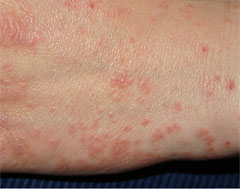
Scabies is caused by small mites (Sarcoptes scabiei) that penetrate into the skin. These mites are too small to see, but cause the skin to become very itchy and irritated. Symptoms usually start to occur 2-6 weeks after infection. You can spread scabies before you even know you have it.
Contracting and spreading scabies
From humans
Scabies is highly contagious and can be caught from direct, extended contact with an infected person. Scabies mites can also survive away from the human body for 24-36 hours, so it is possible to catch scabies from sharing infected linen, towels, and clothing. The mites burrow in to the skin to lay eggs, the eggs hatch, crawl out onto the skin and make new burrows. Scratching the infected area promotes spreading of eggs and newly-hatched insects to other parts of your body.
From animals
The mites that cause scabies in animals like horses and dogs are different to those that cause scabies in humans, but humans can still catch these scabies (also known as mange). These mites do not jump from animal to animal or human, but close contact with infected animals allows the mites to penetrate the skin. Unlike human scabies, the mites do not burrow into the skin, but sit on the skin, dissolving skin with saliva. This causes a rash that arises from an allergic reaction to the mite’s faeces. While mange can live in domestic and farm animals for over a month, they only survive a few days in a human. Importantly, the mite is unable to reproduce on the human body.
Symptoms
- Rash:
- In terms of human-to-human scabies, there might not be much of a rash, as the mites are underneath the skin.
- An allergic reaction from animal-to-human scabies will produce a rash. It looks like tiny red lumps and threadlike tracks on the skin.
- Itchiness is part of the body’s immune system response to the infection – you may get very itchy a day or two after you get infected, which can last beyond treatment, for up to three weeks.
- Lesions and spots on the skin filled with fluid
- Small visible ‘burrows’ in the skin particularly between the fingers (human scabies virus).
Treatment
- Calamine lotion can be applied to the irritated area to manage the itching.
- A lotion or cream can be purchased from the chemist to treat scabies (Permethrin). Instructions should be followed carefully. Your partner and family members should also be treated at the same time.
- Wash clothes, bedding and towels in hot water. Items that cannot be washed should be sealed in bags for 72 hours.
- Pregnant or breastfeeding women and children should see a doctor before using any over the counter medications.
Prevention
The best way to prevent infection is to maintain good personal hygiene, like regular hand washing and not sharing clothes or bedding with infected people. If you develop scabies, your sexual partners and all members of your household should also be treated with a scabies cream or lotion. If you have contracted scabies from an infected animal, it is important to treat the animal and clean items they have had contact with, including; beds, rugs, and saddles.
Find out more about this topic on Better Health Channel
Fast facts:
- Scabies is caused by tiny mites that penetrate into the skin.
- Infected skin becomes very itchy and scratching spreads the eggs to other parts of your body.
- Infected farm animals can pass on scabies (or mange) mites to people. These mites are specific to the animal they come from and will not breed on human skin, but they will make your skin itchy and irritated for a few days.
- Scabies can be treated with lotions or creams from a chemist.
References used for this topic
More information:
Healthdirect
Scabies
Department of Health (Vic)
Scabies
Clinical care:
Department of Health (Aust)
Arthropod pests of public health significance in Australia – 2013
Parasitipedia.net
Horse mites: biology, prevention and control
SA Health
Scabies diagnosis and management
Queensland Government
Scabies
Research & reviews:
Clinical Microbiology Reviews
Problems in diagnosing scabies, a global disease in human and animal populations
Cochrane Collaboration
Interventions for treating scabies
|
|